INTERSPEECH 2026 · Sydney

Ecologically-Constrained Task Arithmetic for
Multi-Taxa Bioacoustic Classifiers Without Shared Data

Ragib Amin Nihal1, Benjamin Yen1,2, Runwu Shi1, Takeshi Ashizawa1, Kazuhiro Nakadai1

1 Systems and Control Engineering, Institute of Science Tokyo, Japan  ·  2 RIKEN BDR, Japan

TL;DR — Bioacoustic training data is scattered across taxa, regions, and institutions, and often cannot be centralized. We show that independently fine-tuned BEATs encoders can be composed into a unified 661-species classifier via task-vector arithmetic — sharing only weights, never data. Bioacoustic task vectors turn out to be near-orthogonal (cosine 0.01 ± 0.09), a geometry that tracks spectral distribution distance (the acoustic niche hypothesis). This makes simple averaging optimal, makes sign-conflict methods like TIES harmful, and creates an asymmetric gap that benefits underrepresented taxa.

The idea in one picture

From acoustic niches to composable weights

(a) Taxonomic groups concentrate vocal energy in non-overlapping frequency bands. (b) Classifying them modifies largely disjoint parameter subsets, so their task vectors are near-orthogonal (magnitude ∝ dataset size). (c) Averaging the vectors and adding them to the shared pretrained encoder yields a multi-taxa classifier — no joint training, no shared data.

Abstract

Training data for bioacoustics is scattered across taxa, regions, and institutions. Centralizing it all is often infeasible. We show that independently fine-tuned BEATs encoders can be composed into a unified 661-species classifier via task vector arithmetic without sharing data. We find that bioacoustic task vectors are near-orthogonal (cosine 0.01±0.09). Their separation aligns closely with spectral distribution distance, a gradient consistent with the acoustic niche hypothesis. This geometry makes simple averaging optimal while sign-conflict methods reduce accuracy by one to six percentage points. Composition also creates an asymmetric gap: species-rich groups lose accuracy relative to joint training while underrepresented taxa gain, a redistribution useful for equitable biodiversity monitoring. We verify linear mode connectivity across all taxonomic pairs, demonstrate zero-shot transfer to new regions, and identify domain negation as a boundary condition where composition fails. These results enable a collaborative paradigm for bioacoustics where institutions share only task vectors to assemble multi-taxa classifiers, preserving data privacy.

Contributions

Three key findings

1

Composition without shared data

Five independently fine-tuned species-group models compose into a 661-species classifier at 59.2% accuracy — 86% of a jointly-trained baseline — and regional models reach 91% of dedicated performance.

2

Ecology predicts weight-space geometry

Task vectors are near-orthogonal (cosine 0.01 ± 0.09), rising from cross-taxa (0.01) to intra-avian (0.08) to regional (0.08) pairs. This gradient correlates strongly with spectral distribution distance — the acoustic niche hypothesis, in weights.

3

An asymmetric gap that helps minorities

Merging redistributes capacity from majority to minority taxa: passerines −11.8% while marine mammals +3.9% and amphibians +1.9% — useful for equitable biodiversity monitoring.

Animated explainers

The mechanism, in motion

Task arithmetic in weight space. A trained model is a point; each specialist is a near-orthogonal arrow (cosine 0.01–0.09). Because the arrows barely overlap, averaging them onto θ₀ preserves every specialist's knowledge.

The asymmetric gap. Relative to joint training, species-rich majority taxa lose accuracy while under-represented taxa gain — a redistribution useful for equitable monitoring.

Method

Task vectors, and how to combine them

From a shared pretrained encoder θ₀ and a model fine-tuned on group i, the task vector τᵢ = θᵢ − θ₀ captures what was learned (encoder weights only — classification heads are discarded). The simplest composition averages them:

θmerged = θ₀ + (1/N) Σi τi

Because the task vectors are pairwise near-orthogonal, no directional interference occurs — performance loss depends only on vector magnitudes, and the dominant term scales with ‖τᵢ‖². Groups trained on larger datasets therefore experience greater dilution, which is exactly why the composition gap is asymmetric. The same orthogonality drives sign agreement toward 0.5, so TIES-style majority voting becomes random.

Build the merged encoder

Each colored arrow is a specialist's task vector, scaled by 1/N and added tip-to-tail onto the base model θ₀ (dashed = full-size τᵢ).

How orthogonal, really?

Even the most similar pairs sit close to 90°. Slide across the empirical gradient:

Why simple averaging wins here

Toggle a merging strategy and see what it does to the task-vector parameters when the vectors are near-orthogonal.

Experiments & results

What the weight space looks like

Experiment 1 · Linear Mode Connectivity

Every fine-tuned pair is connected by a monotonic, zero-barrier interpolation path — the specialists live in a shared loss basin, a prerequisite for merging to work.
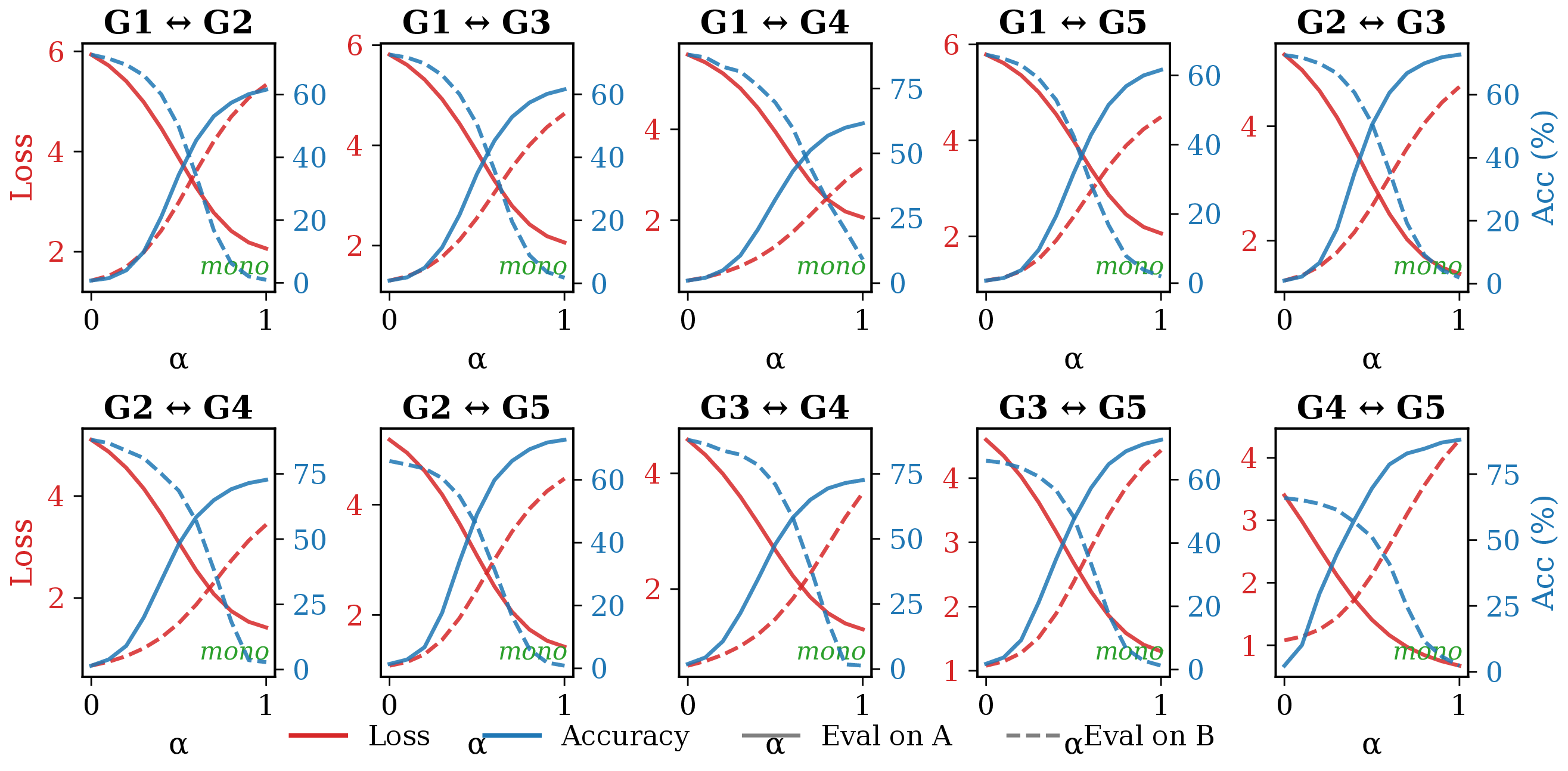
Linear mode connectivity curves for all taxonomic pairs, all monotonic with zero barriers.
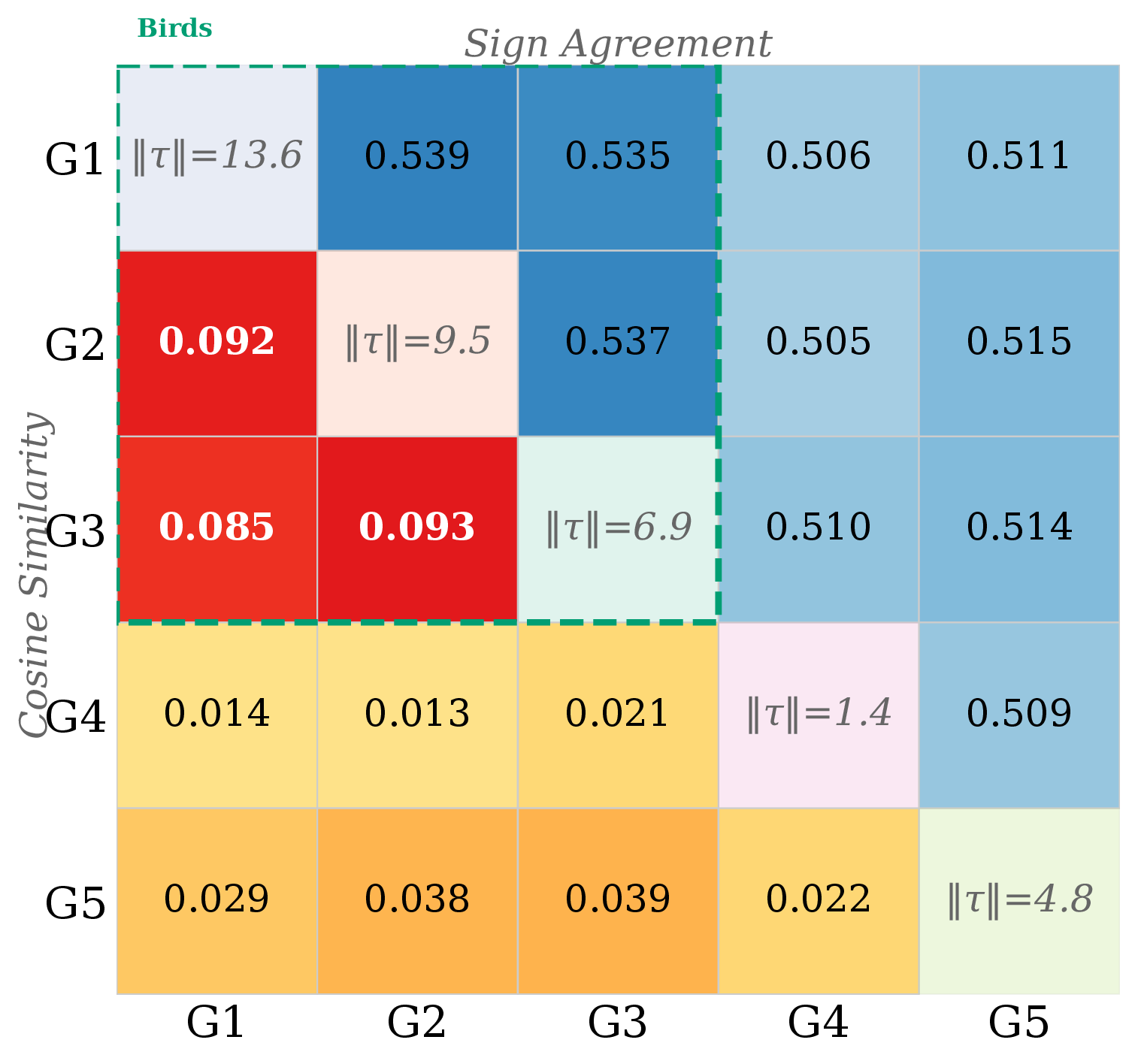
Cosine similarity / sign agreement matrix across groups G1-G5.

Near-orthogonal task vectors. Cosine similarities (lower triangle) are 0.01–0.09; sign agreement (upper triangle) hovers near 0.51 — near-random, which is why TIES discards ~half of each vector.
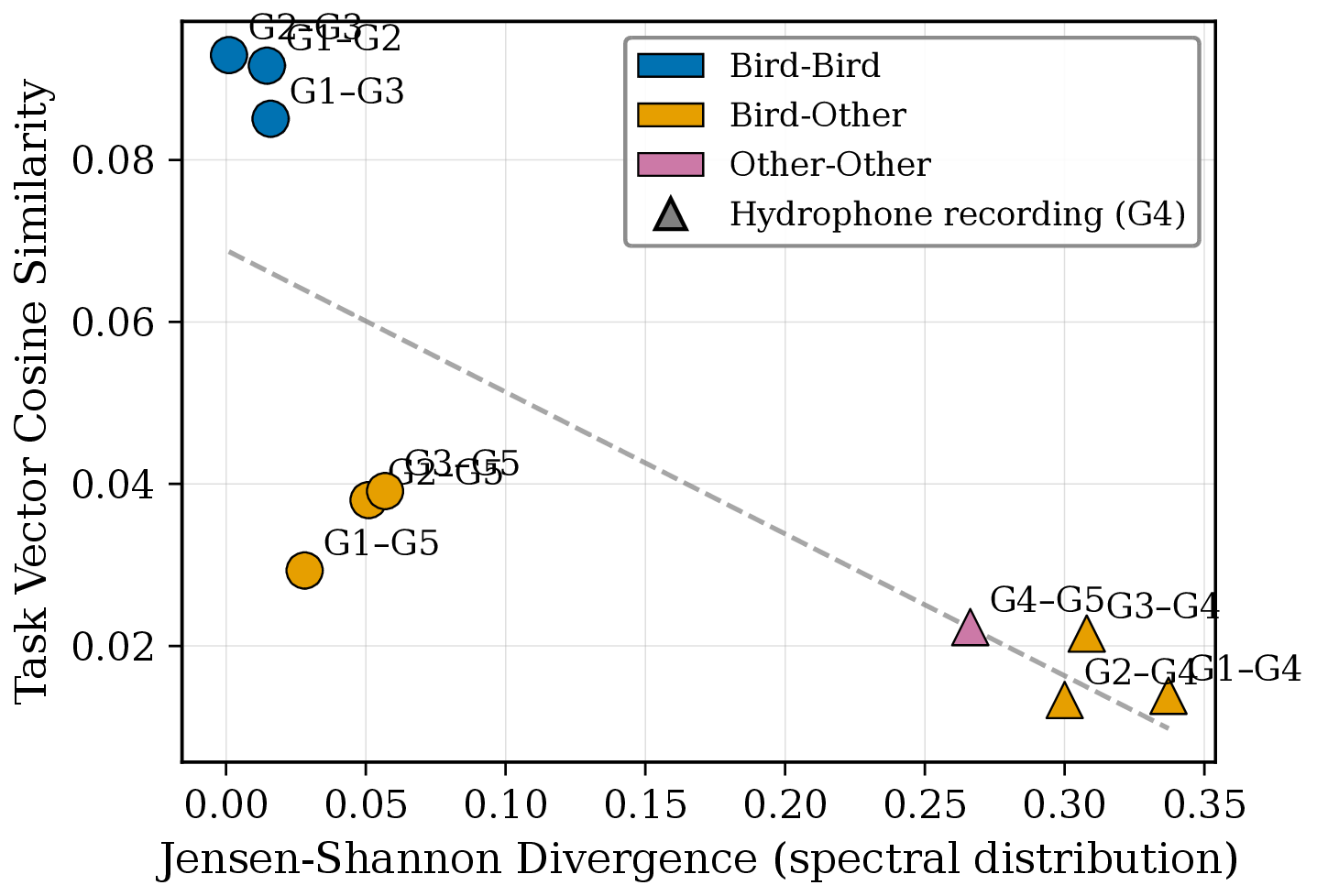
Task-vector cosine similarity versus Jensen-Shannon spectral divergence.

Ecology predicts geometry. Pairwise cosine similarity falls as spectral distribution divergence grows — bird–bird pairs cluster high-similarity, hydrophone-recorded marine mammals sit farthest.
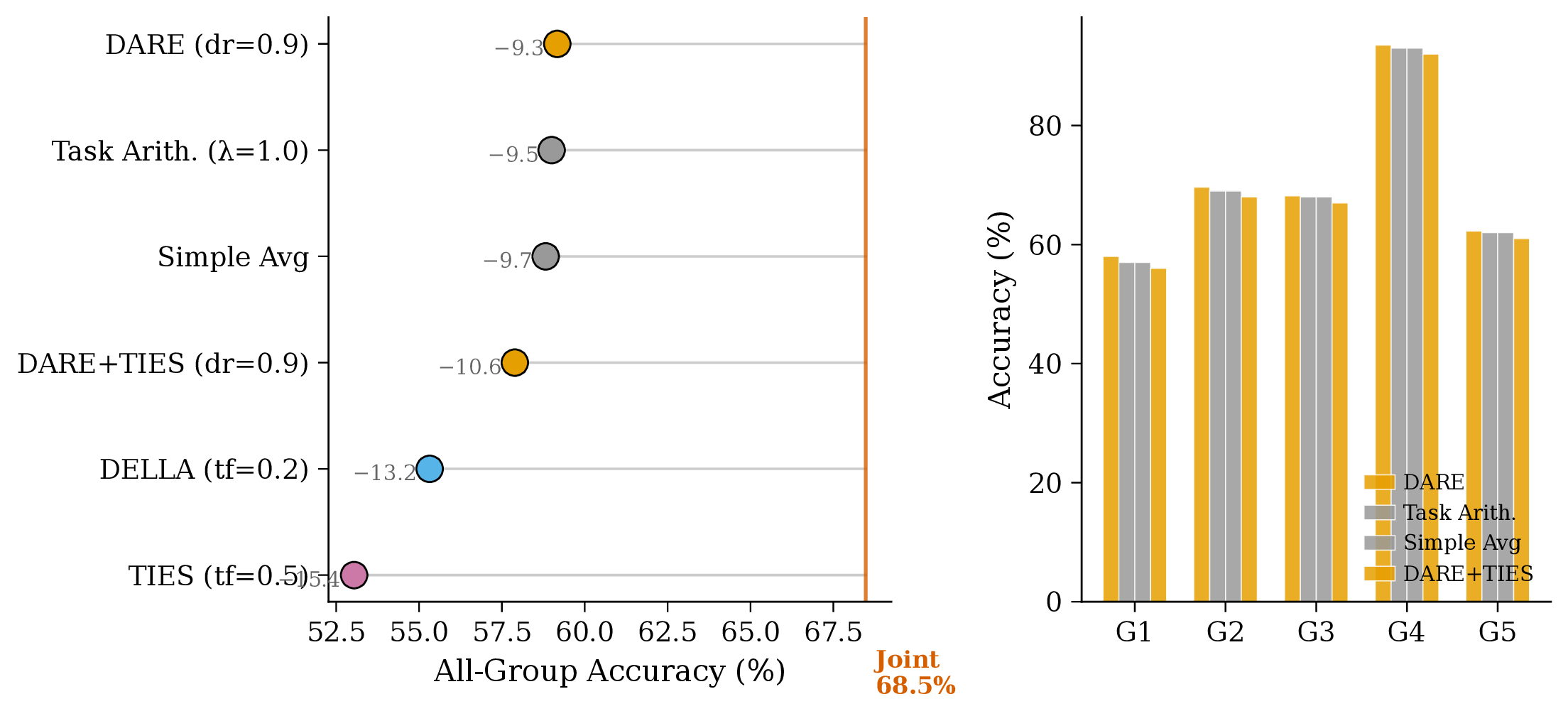
Per-group composition accuracy across merging methods.

Species-group composition. Direct averaging matches or beats every conflict-resolution method; the unified probe spans all 661 species.
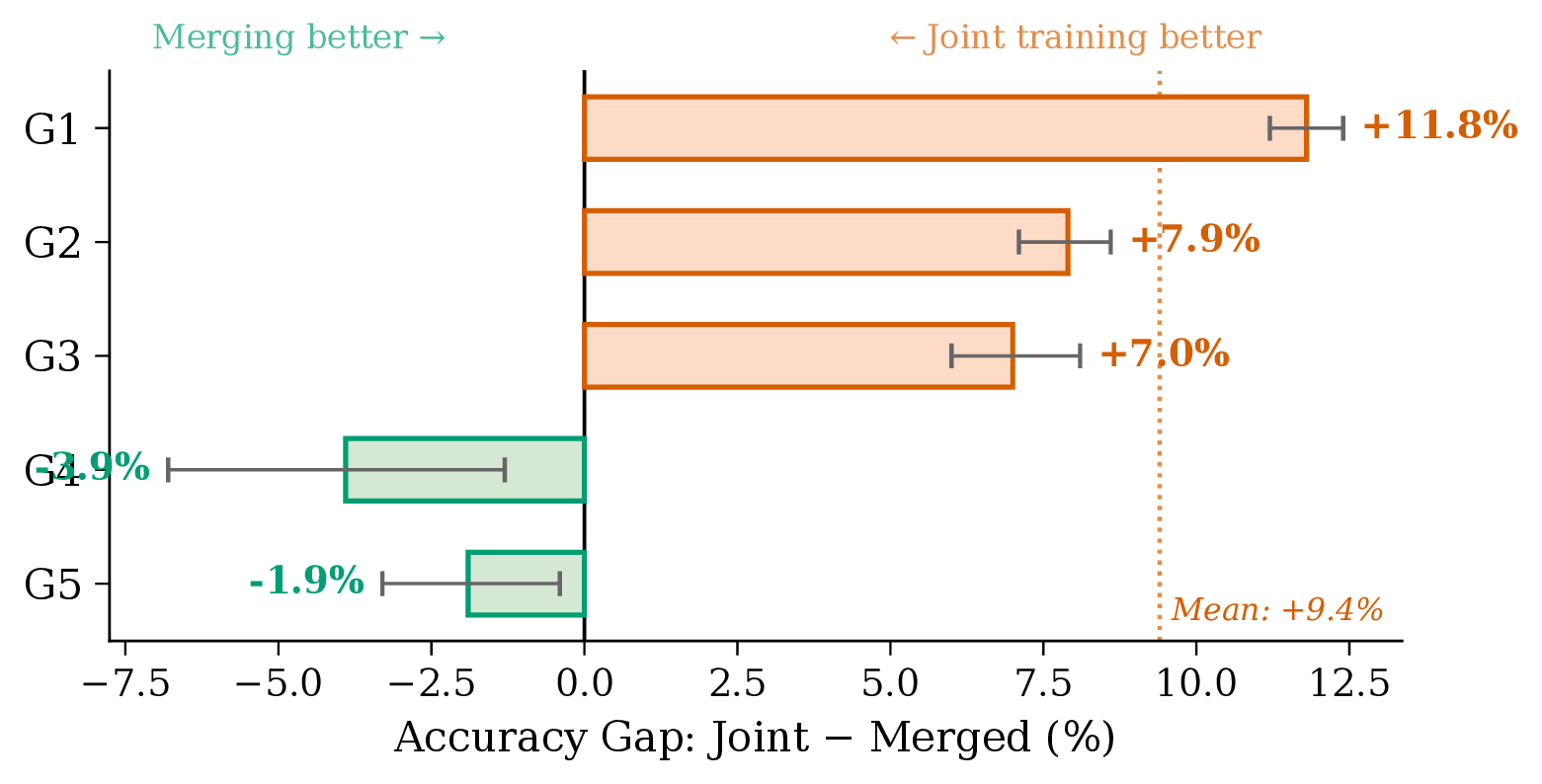
Asymmetric composition gap: majority taxa lose, minority taxa gain.

The asymmetric gap. Species-rich passerines lose accuracy relative to joint training, while data-poor marine mammals and amphibians gain.
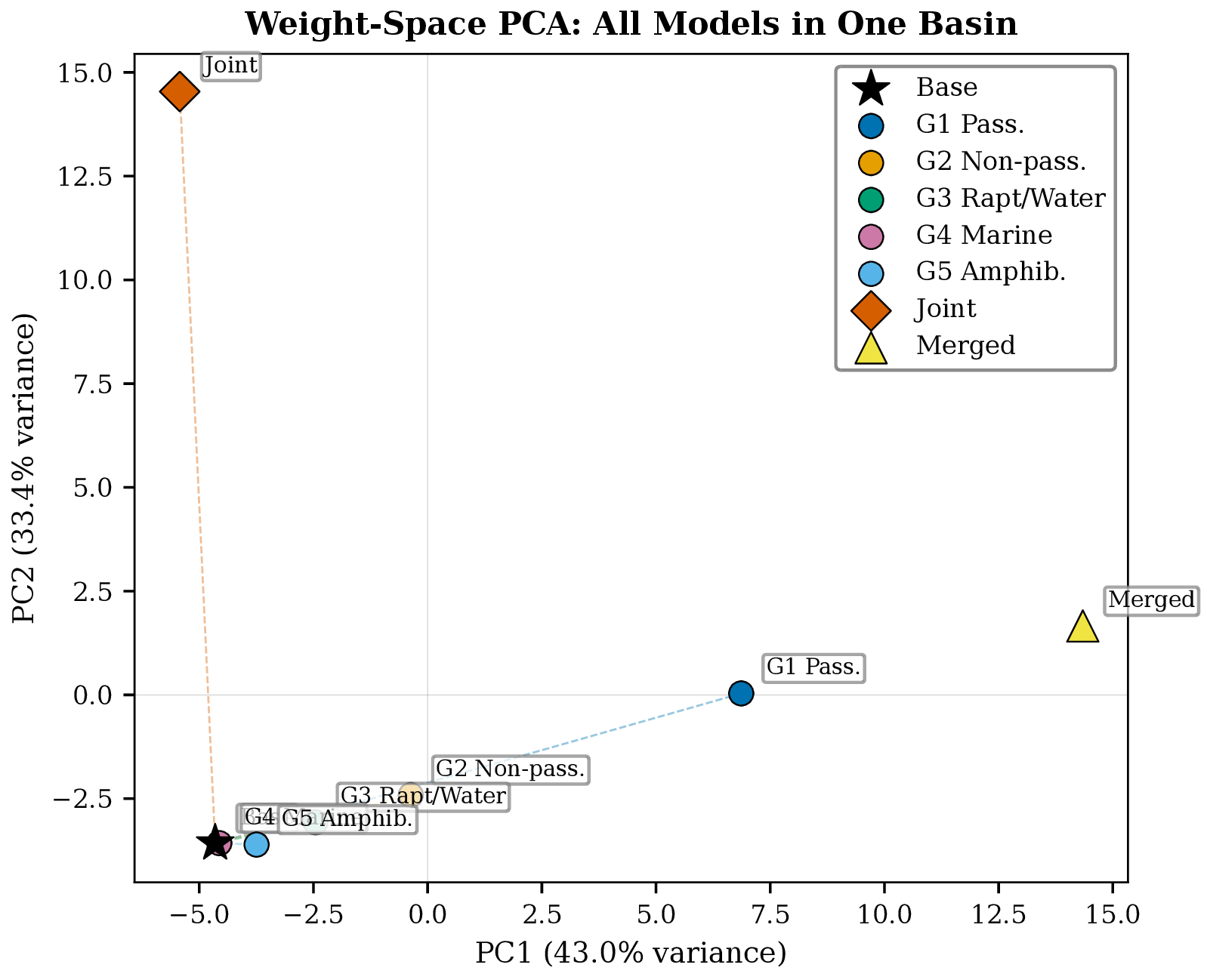
PCA of fine-tuned encoder weights showing modular structure.

Weight-space structure. The first two principal components of the task vectors capture 76.4% of variance and separate taxa.
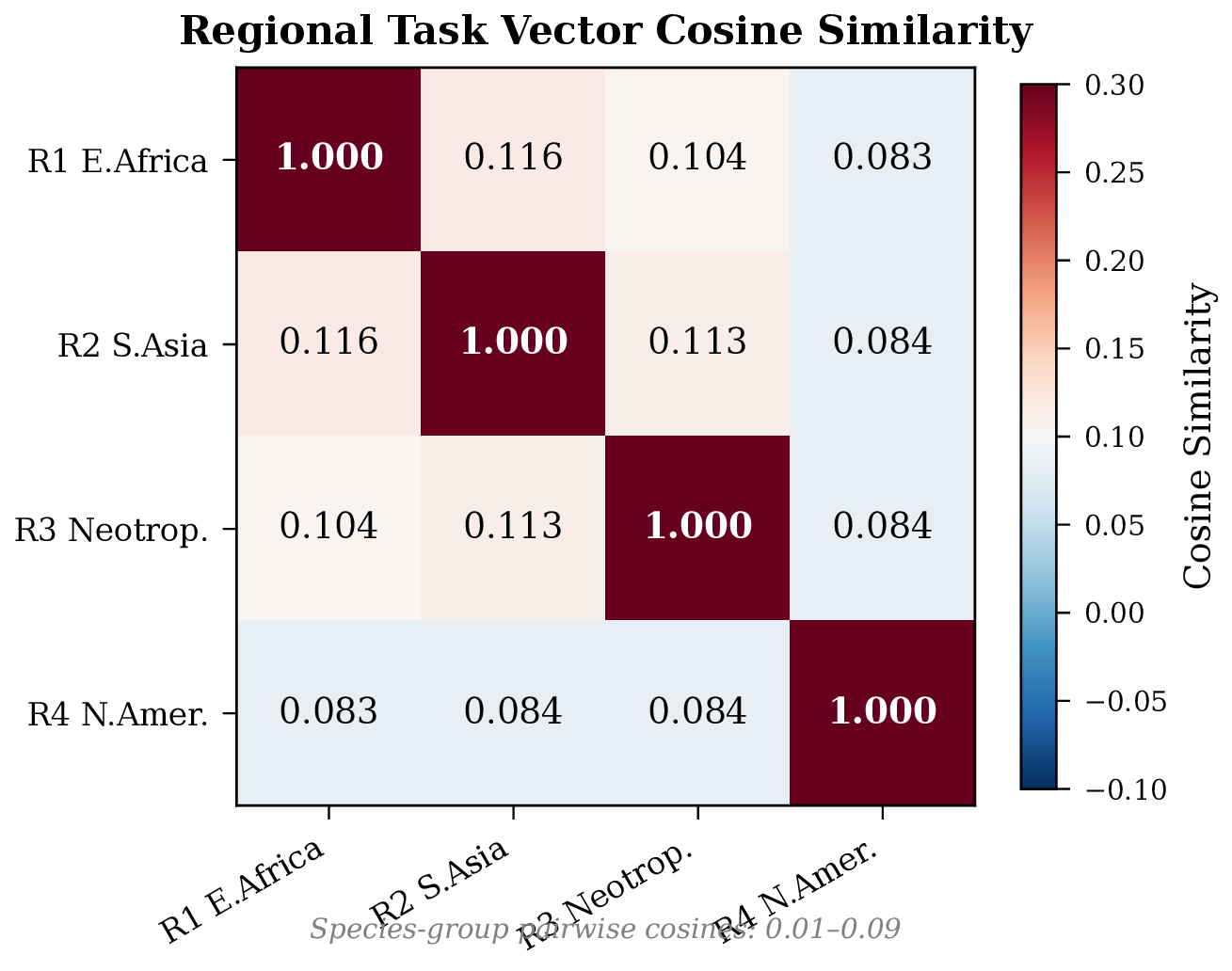
Regional task-vector cosine similarity matrix.

Experiment 3 · Regional composition. Merging geographically specialized models transfers to novel regions, reaching 91% of dedicated per-region performance.
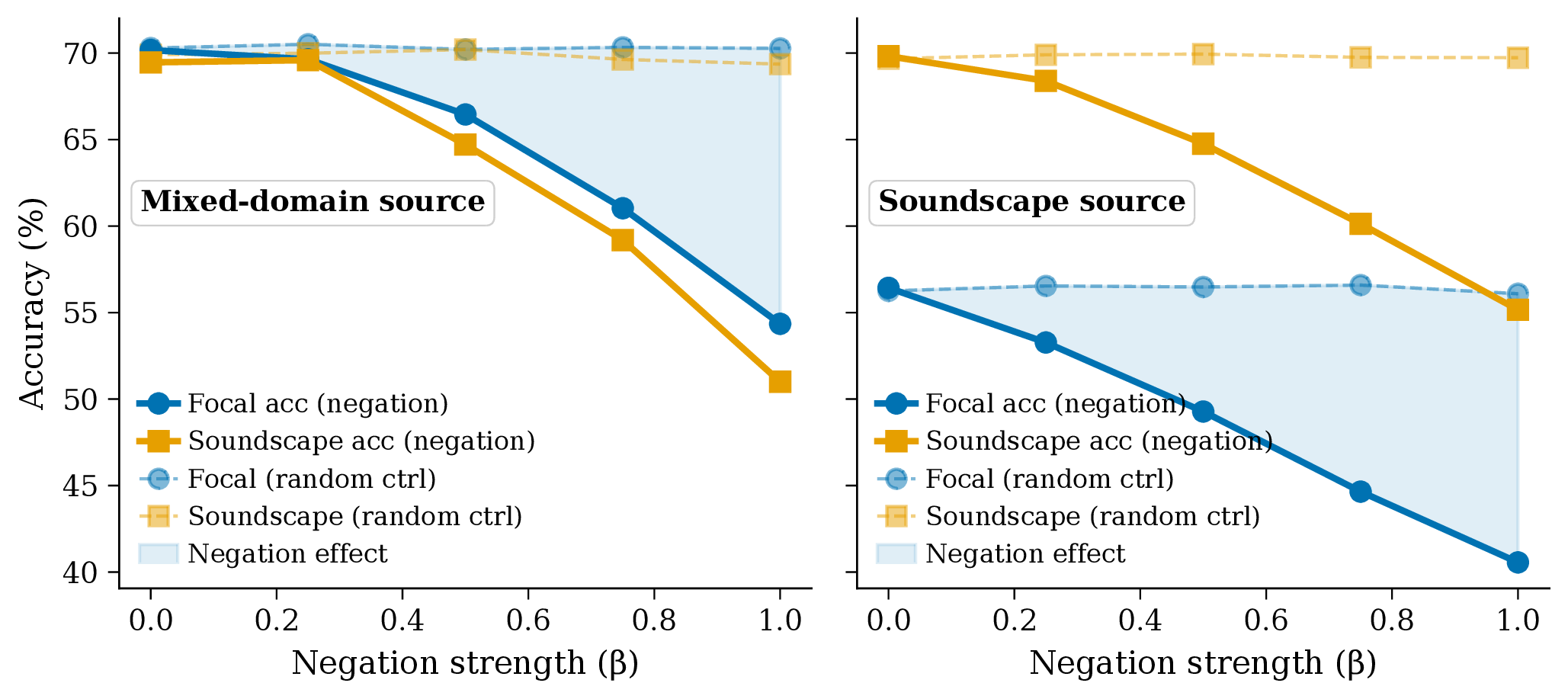
Experiment 4 · A boundary condition

Where composition fails: domain negation

Domain negation curves: subtracting the focal task vector degrades both focal and soundscape accuracy.

Task arithmetic also allows subtraction. We tried removing a “focal-recording” task vector to improve soundscape performance: θnew = θsource − β·τfocal. It fails — both focal and soundscape accuracy degrade monotonically. The focal recording is not a separable style but a canonical representation of species identity, so subtracting it erases core information. A matched random-vector control moves accuracy by only ±0.6%, confirming the degradation is direction-specific. Negation works only when the attribute is truly disentangled from identity in weight space.

Context

A regime that distinguishes bioacoustics from vision

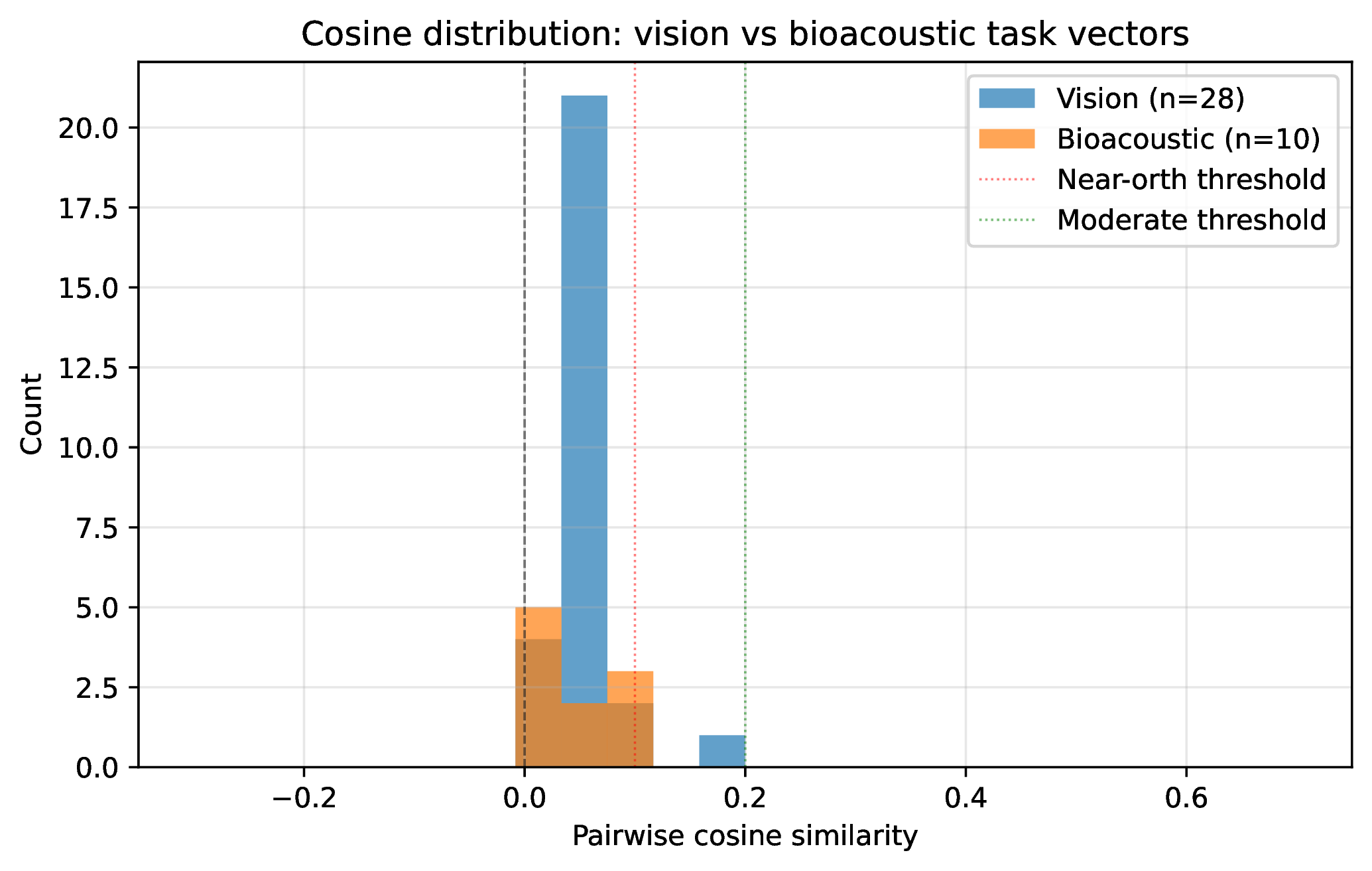
Vision task-vector cosine distribution for comparison.

Acoustic niche partitioning pushes bioacoustic task vectors into a far more orthogonal regime than is typical elsewhere. This is what makes simple averaging the right tool here and conflict-resolution methods counterproductive — and it suggests composition quality can be assessed a priori from acoustic properties alone, before any merging is attempted.

Toward collaborative model building

As monitoring expands to diverse taxa and under-surveyed regions, task-vector arithmetic offers the bioacoustics community a path toward shared multi-taxa classifiers: contribute learned knowledge as a lightweight task vector as ecological coverage grows — without centralizing data or retraining.

BibTeX

@inproceedings{nihal2026ecological,
  title     = {Ecologically-Constrained Task Arithmetic for Multi-Taxa
               Bioacoustic Classifiers Without Shared Data},
  author    = {Nihal, Ragib Amin and Yen, Benjamin and Shi, Runwu and
               Ashizawa, Takeshi and Nakadai, Kazuhiro},
  booktitle = {Proc. INTERSPEECH 2026},
  year      = {2026},
  address   = {Sydney, Australia}
}